Nikos Moschos: From Knossos to the Ends of the World
The painter returns to his childhood whenever he finds himself in his birthplace and gazes, right there next to Knossos, at the hill of Agios Ilias…
10.11.2024
By Maria Agapaki
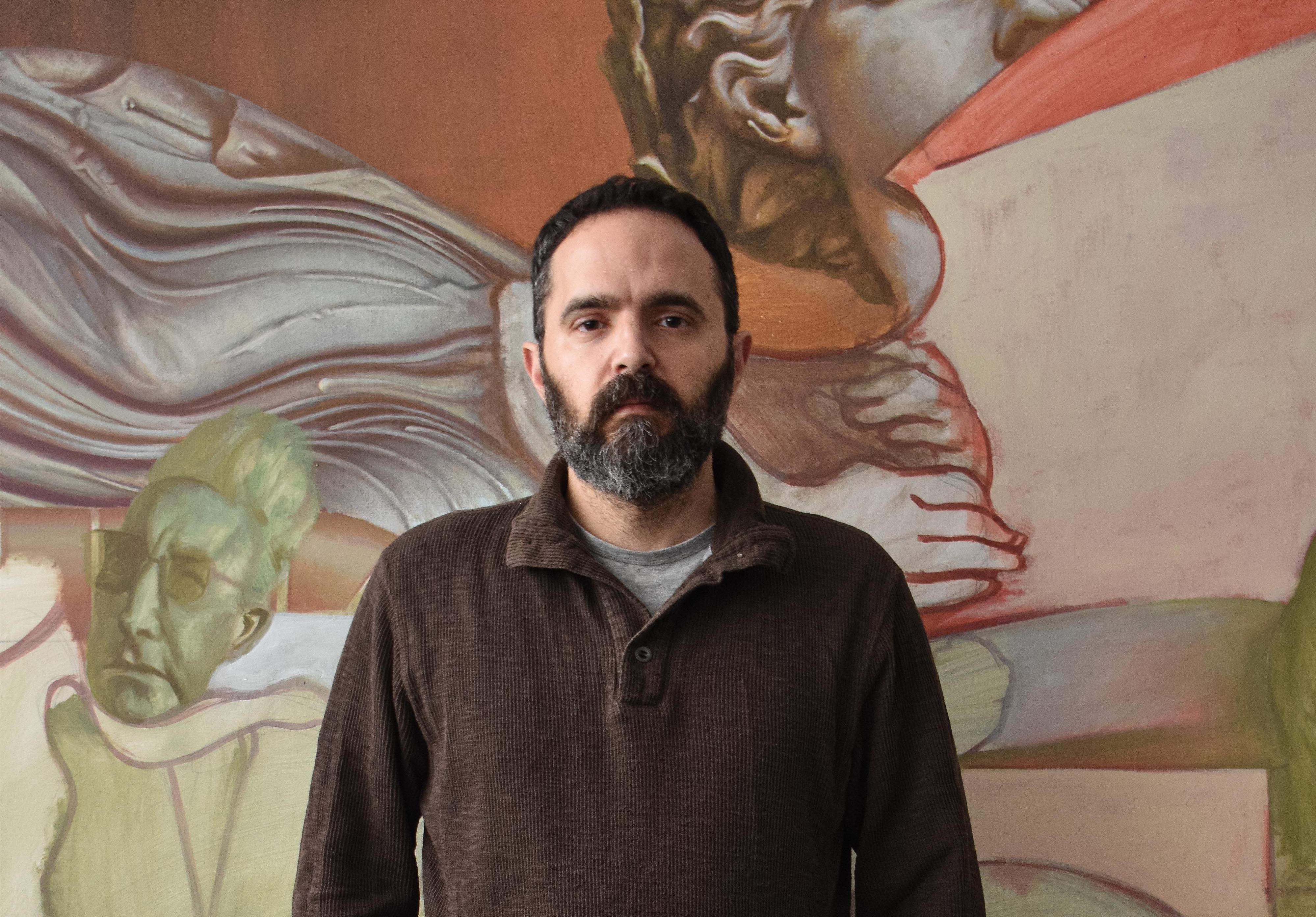
Nikos Moschos, of Cretan origin, was born and raised in Heraklion until the age of 18, when he left to study at the Athens School of Fine Arts. From then until today, he has followed an admirable career, as, in addition to Greece, he has exhibited in several cities abroad such as Vienna, Basel, Brussels, Istanbul, Beijing, among others, while his works can be found from New York to Singapore.
His paintings resemble a deconstructed puzzle, like an image in constant evolution, giving each individual element its own dynamic. Perhaps without realizing it, each of his responses also constitutes an indirect political commentary. His art highlights color, light, intensity, and the form of each figure. Nikos Moschos’ paintings tell a story with a beginning but no end. The epilogue belongs exclusively to the viewer.
The full interview:
CL– Did exhibiting in your hometown carry a special emotional weight for you? How did the phrase “Marginally Human” come about?
– The exhibition at the Basilica of Saint Mark in 2019 was one of the most important milestones of my exhibition career so far. First of all, it was my first solo presentation in my birthplace. I was given the opportunity to present to my fellow citizens (and not only them) a large part of my artistic journey up to that point. I must admit that I felt slightly more anxious than usual; anxiety, you know, is always present in an exhibition and largely determines its success. In this case, however, it was somewhat different. I felt as if I were returning for the first time since 1997, the year I moved to Athens to study at the School of Fine Arts.
From time to time, I had presented works in group exhibitions on the island, and many people followed my work online. Still, the feeling of direct contact with the works, especially on such a scale, is always different. Even for me, it was a unique opportunity to stand face to face with the production of the previous decade and take stock of my work. To observe my evolution from 2012 onwards—the year when my work, while remaining figurative, acquired an even more distorted dimension.
That first complete presentation took place in 2012 at the Xippas Gallery and was titled “The Marriage of Flesh and Machine.” It laid the foundations for the concerns that continue to occupy my work to this day. In that body of work, the relationship between humans and machines dominated, with the machine taking on allegorical dimensions, reflecting our love–hate relationship with technology, the excesses that overwhelm contemporary life, and the constantly shifting values it shapes. These transitions are abrupt, and their protagonists, in order to survive, are often led to dehumanization.
On this theoretical framework, art theorist Christoforos Marinos focused his perspective and writing when he composed the introductory text for the exhibition “Marginally Human.” There he briefly refers to a text by philosopher Peter Sloterdijk, who analyzes the concept of transhumanism as a byproduct of mass culture. At one point, Sloterdijk challenges the reader to replace the dystopian-sounding prefix “post-” that precedes all functions in the new order of things with the adverb “marginally.” From this prompt, we drew inspiration for the title of my exhibition.
I would like to take this opportunity to once again express my gratitude to the Region of Crete—specifically the then Vice Governor for Culture, Kostas Fasoulakis—for the organization, to the Municipality of Heraklion and former Deputy Mayor for Culture Aristea Plevri for their collaboration, and to everyone who contributed to the realization of the exhibition. Special mention must be made of the contribution of my dear friend, academic and researcher Nikos Mathioudakis.
CL– Your paintings are strikingly revealing. How would you yourself describe your work?
– I find it difficult to define my work with a single term, or even descriptively. This is a common issue for many contemporary artists, as we are asked to approach something through the lens of the past, even the recent past. Thus, although we feel that we come from something familiar, there are many differences—formal, conceptual, or intentional.
Usually, in order to establish an initial channel of communication with the viewer, I describe my works as allegorical in content. Of course, this is not sufficient, since allegorical representations have permeated the history of art for centuries. As for the formal aspect, it is even harder for me to categorize it, as recognizable and abstract elements function on equal terms.
In the visual arts field, I am classified as a figurative painter, which I accept. Nevertheless, the process through which I begin each work stems from a combination of abstract structures that define it from its inception to its completion.
CL– Social sensitivity, love, death, art. What drives your artistic expression? What is the force that motivates you to give form to your works?
– The issues you mention—futility, death, love, and so on—have always been and continue to be central or subsidiary themes not only for artists, but also for writers, philosophers, and others. Through these, each artist expresses a personal perspective on life. They become the framework within which the artist reveals themselves and possibly expresses something deeper, beyond the thematic boundaries themselves.
What I mainly try to approach through these themes is the constant transition and adaptation to new realities, the reconstitution of matter and concepts, and by extension of the psyche itself—in short, humanity’s effort to cope with the fluid frameworks it creates.
CL– You began artistically with Byzantine art. What came next?
– My contact with Byzantine art began in the environment in which I was born and raised, through my father, Takis Moschos, an icon painter and conservator. I have never painted a portable icon or a fresco. Whatever I have gained comes from observing the works and their creative process. If I remember correctly, as a child I made a few drawings copying works, without pursuing it further.
Perhaps my lack of deeper involvement was due to my blind admiration for Western painting, especially artists characterized by exuberance, such as Tintoretto or Rubens. My interest in Byzantine art returned around 2010, when I turned to it while searching for solutions to a more expressionistic dimension my work had acquired at the time. I began working almost entirely from imagination, and unconsciously—at least initially—the influences became apparent.
The works started to show stronger elements of distortion, immediacy, and stylization. Conceptually, I felt as though I were setting up a theatrical stage full of symbols and riddles, resulting in a paradoxical outcome that many describe as surrealistic. I would like to clarify that surrealism and its principles never interested me, and paradox is not its exclusive characteristic. Unfortunately, today, as terms become increasingly oversimplified, anything that appears illogical is labeled surreal.
Of course, we might accept—even if we don’t like it—that artistic and ideological movements evolve and intermingle over time, and we must take a position on this, at least those who wish to view the evolution of history and art through established terminology.
CL– Your works are powerful, with social messages—a clear punch to our established daily life.
– Every work reflects an attitude toward life. Even the most indifferent or banal one reveals something about its creator’s character—not only through subject matter, but also through how it is made.
My list of personal heroes—my imaginary museum—includes many artists with strong social and existential concerns. Some clearly express political positions, which are often reductively labeled as “committed art,” a term that, in my opinion, unjustly relegates artistic value to the background. For example, the most significant works of artists like Grosz or Siqueiros arose from their social concerns and were formally shaped through them.
On the other hand, I greatly admire Bacon, who held completely different political views, yet was driven by the same—if not stronger—existential anguish. Personally, I do not seek to preach or propose alternative forms of social conformity. I neither intend nor believe I possess the qualifications for such an endeavor.
I do not aim to guide the viewer ideologically. My goal is to metabolize my thoughts and questions into images. Shapes, colors, and every element—recognizable or not—form a parallel universe that gives rise to each issue allegorically. Each viewer is free to find their own answers.
CL– What are your influences?
– There is a multitude of artists who have influenced my thinking and continue to challenge my perception. Indicatively, I would mention Tintoretto, Bruegel, El Greco, Rubens, Goya, and giants of the last century such as Dix, Grosz, Beckmann, Höch, as well as Picasso, Caro, Bacon, and Kitaj. Among more contemporary artists, I would cite Kentridge and De Cordier, despite his diametrically opposed perspective to my own.
This brings me to note that my work has been clearly shaped by artists with whom I share affinities, while over time it has also been internally challenged by heterogeneous “voices.” These unfamiliar voices exert the strongest criticism and ultimately push us one step further.
CL– Art is culture and shapes character. What would you suggest: a) to the State and b) to young people?
– I would answer your question with a series of questions, such as “What would we like to change?” after asking “Do we believe something should change?” or “What do we consider art and where are its boundaries?” and so on.
Forgive the slightly humorous tone of my introduction, but reading the first part of the question brought to mind clichéd images of politicians in nightclubs—and I believe I’m not the only one for whom this image has become ingrained.
One might say I lack the expertise to answer such a question, and they wouldn’t be entirely wrong. People like me might either present utopian ideals shaped by personal aesthetics or dismantle everything with passivity and fatalism. You will likely find me somewhere between these tendencies.
Nevertheless, art, in whatever form, can play a decisive role in shaping character—not only for children but for adults as well. When supported by people who believe in its power and work with knowledge and passion, the results can be remarkable. A clear example is conductor and composer José Antonio Abreu, who selected children from Venezuela’s poorest neighborhoods and created the Simón Bolívar Orchestra. Through it, he launched a new educational system using music to combat violence and drugs. Today, under state care, it includes around two hundred youth orchestras and offers workshops in instrument-making and music studies. Many distinguished musicians have emerged from these neighborhoods—many children quite literally saved their lives through music.
Thus, art’s role is not limited to aesthetic cultivation (which our urban environment clearly lacks), but extends to self-knowledge, emotional intelligence, and functional engagement with both immediate and broader environments. Especially in an era where values and role models are imposed by social media, engagement with art becomes ever more urgent. Artistic activity can counterbalance inner emptiness and passivity, sharpening critical faculties and fostering more active, responsible citizens.
CL– How has Crete influenced your work? What does it symbolize for you? What are your childhood memories?
– In recent years, my visits to the island have become less frequent due to professional obligations. Each visit triggers inevitable comparisons and imaginary scenarios of a parallel life. “What if I had lived here?” “What if I had returned—or never left?” I would certainly be a different person, a different artist, or perhaps have pursued a different path altogether.
I grew up at Knossos, and my family home faces the hill of Agios Ilias. This relatively unknown hill lacks the dramatic features of Crete’s famous mountains, yet its image is deeply engraved in my mind, as it framed the view of my childhood and adolescence.
From early on, it also became a field of painterly practice. I have painted the mountain—or rather parts of it—countless times and continue to do so whenever I return. From the cool tones of morning to the ochres and siennas of afternoon, gradually giving way to violets and purples, each part of it feeds my mind with painterly problems demanding organization and resolution.
Nature, and studying it outside the studio, always helps me shed the obsessions that occupy my mind indoors. It feels like a wonderful opportunity to let go more freely, even as I struggle to tame the stimuli I receive. It’s hard to explain to someone who doesn’t paint, but it’s as if I forget everything and start anew each time—especially when facing a landscape intertwined with my entire life. Subconsciously, I feel that whenever I return there, I return to a pure and unpretentious apprenticeship. In this place, facing Agios Ilias, time seems to stand still, and I remain forever a wide-eyed student.
Thank you.
Nikos Moschos’ new exhibition opens on Friday, November 15, in Nicosia.