By Giorgos Mylonas
Art Historian
Stand In Line Art Space
Nikos Moschos
Cryptic Psychograms with Fractured Unity
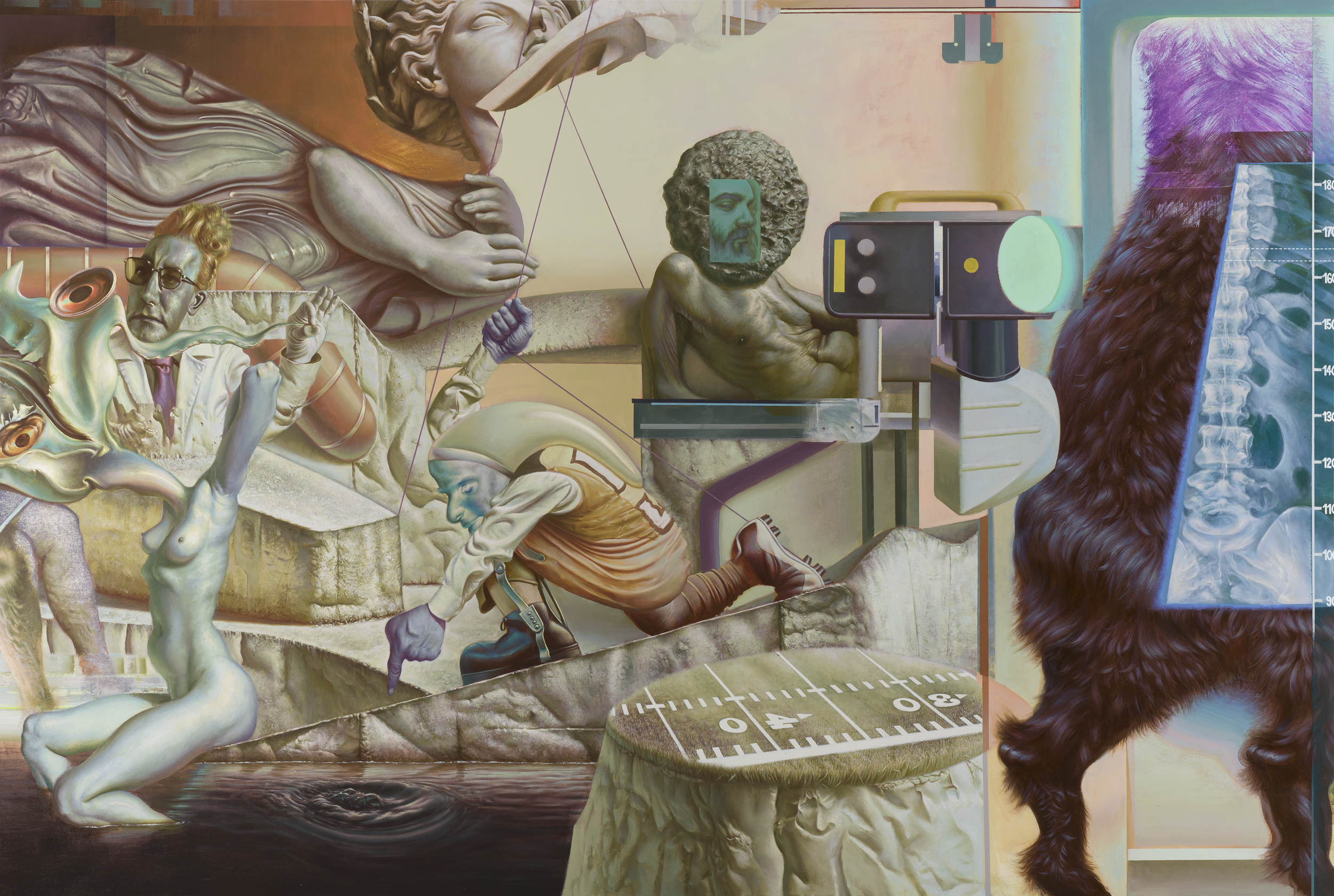
The sleeplessness of reason…, 2024, acrylic and oil pastel on linen, 290x195 cm
Young in years, when he left Knossos, Crete, to study at the Athens School of Fine Arts, Nikos Moschos had his senses set at high intensity. Everything he saw and heard was metabolized into his work with impressive draftsmanship—remarkable for someone so young—and with a sensitivity that quickly distinguished him from the artists of his generation. This quality, of approaching the world through a unique filter, not only remained intact over time but was enriched with intellectual resources and fruitful questions.
Today, at 45, Moschos formulates his questions about the world and the position of modern man within a flow, a river into which fragments are constantly falling, forming the human face. This is how his works may be seen: as cryptic psychograms with fractured unity. Successive associations, beginning from reality and filtered through mental shifts and transcendence, are distilled into his art allegorically. Faithful to the nature of painting, he records life as a reflection of fragments, as a dream. The deliberate ambiguity of his narrative creates a sense of inner wandering and an emotional current toward favored images—scenes from the Altar of Pergamon at Berlin’s Pergamon Museum, familiar faces, personal experiences—through which he shapes a new space, open to memory and fantasy. His images, statuesque and colorful, in a palette that never reaches excess, interpenetrate one another, just as associative thoughts do in our minds. We cannot connect the scenes with logic. We must let go and wander through them.
From his most recent body of work, we may pick up the thread with the composition titled The sleeplessness of reason…—a “descendant” of Goya’s emblematic series of etchings The Sleep of Reason Produces Monsters. In a tone equally distant from light and darkness, reminiscent of 1970s photography, the artist proceeds as follows: he shapes images by blending recognizable and abstract elements. These, although initially disconnected, eventually interpenetrate, weaving a story that does not belong to a specific place or time. Beneath the marble body of Apollo Musagetes emerges the figure of Dr. Strangelove (Peter Sellers in Stanley Kubrick’s celebrated film), while in the center we recognize the artist’s own face on the aged body of an otherworldly figure.
“Works cannot exist if they are not carriers of ideas and emotions. When they have no reason to exist, they become merely decorative elements,” I quote from the painter’s interview. What, then, is Moschos’s purpose—what preoccupies him? The digital age, spearheaded by artificial intelligence and its breakthroughs in various fields, provokes feelings of fear and an anxious search for a stable frame of reference. The explosive triumph of digital technology seems to have pulled the rug out from under our feet, stripping away any stable worldview, introducing us to a kingdom of chaotic conceptualization that replaces the object, and imposing rhythms that allow neither rest nor even adaptation. What for centuries was a “thing” is now a “construct.”
Science has led us into such abstractions that our logic—Euclidean though it may still be—cannot transmute. We follow these abstractions theoretically—of a matter that is now quasi-matter, in quasi-time, quasi-space—yet it is impossible for all this to become lived experience, to become a way of life. Our knowledge increasingly contradicts and cancels out our experiential reality. And as our “world” is composed as much of knowledge as of lived experience, a feeling of emptiness fills the gap between these two.
The painter is not a technophobe, nor does he attempt to turn his brushes into a scourge against science. Yet as there have never been—and can never be—societies capable of absorbing a technology that surpasses them, every era of major scientific discoveries provokes a technological Valhalla within existing social structures. The painter is a man of his time, and his voice is that of a creator whose thought extends universally. In an age ruled by the speed of information, Moschos seeks to open the possibility of another kind of experience, a more radical, essentially poetic way of thinking.
For Moschos, time is not linear: past and present coexist, giving rise to a new reality. Time is shattered, becoming prismatic, like a mirror in which images intertwine, subjecting the viewer to multiple networks—alterations, luminous distortions of space and time—with autonomy, materiality, and a life of their own. Through a painterly collage approaching the logic of cinematic montage, he continually fuses present with past, yesterday with tomorrow. The unorthodox montage of this multilayered reality—through images from memories, dreams, and an emotional perception of the material world—offers us the experience of an inner space.
The entire work of Moschos balances between the metaphysical and the realistic. It is complex but sincere, subjective but not egocentric. His compositions are not “easily digestible” and are not meant for the hurried viewer. His work demands time, calm, and focus; his language is full, rich, distinctive, often requiring active participation from the viewer. His greatest gift, however, is that he can easily engage with an international audience (his works belong to the Fondazione Orestiadi / Sicily, Sammlung Schirm / Berlin, PTE Fine Arts / New York, Bernard Cheong Collection / Singapore).
Born in Heraklion, Crete, in 1979, he received his first lessons from his father, also a painter, Takis Moschos. “One of my favorite places, then and now, was his studio, where I spent endless hours studying, copying, and discussing,” he has said. He studied at the Athens School of Fine Arts (1997–2003), and already during his student years collectors had begun to acquire his work.
References from ancient Greek sculpture, the Baroque, Expressionism (Francis Bacon’s distortions), Neue Sachlichkeit (Otto Dix, Max Beckmann, George Grosz), as well as comics, cinema, and the Dada movement’s sculptural machines, enrich his personal idiom without overwhelming it. He metabolizes all this into a chromatic and stylistic language full of movement, fluidity, and constant alternation of states, human experiences, and emotions. His CV is rich with participations in international exhibitions—the most recent held this past summer in Basel, Switzerland, at the VOLTA Art Fair.
This marks his first solo exhibition in Cyprus, hosted at Stand In Line – Art Space.
Biography
Nikos Moschos was born in 1979 in Heraklion, Crete. He studied at the Athens School of Fine Arts (1997–2003). He lives and works in Athens.
He has held eleven solo exhibitions: in 2024 at Stand in Line – Art Space (Nicosia, Cyprus) and at VOLTA Art Fair with Depo Darm, in 2021 at the Bazeos Tower (Naxos), in 2020 at Zoumboulakis Gallery (Athens), in 2019 at the Municipal Art Gallery / Basilica of St. Mark (Heraklion, Crete), in 2016 at SWAB Art Fair (Barcelona) with ENA Contemporary Gallery, in 2014 at SWAB Art Fair (Barcelona) with ALMA Gallery, in 2013 at Art Athina with Gallery Penindaplinena (Athens), in 2012 at Xippas Gallery (Athens), in 2010 at Galerie Theorema (Brussels), and in 2007 at Ekfrasi – Yianna Grammatopoulou Gallery (Athens).
He has participated in many group exhibitions in Greece and abroad, including the Benaki Museum (Athens, 2004, 2007, 2009), the Goulandris Foundation (Athens, 2022), the Athens Municipal Gallery (New Greek Painting 2023), Thessaloniki (State Museum of Contemporary Art 2007, Museum of Byzantine Culture 2021, Archaeological Museum 2023), as well as in Italy (Bologna 2003, Venice 2008, Rome 2009, Palermo / Museo Diocesano 2019, Genoa / Museo di Sant’Agostino 2019, Sala Liguria / Palazzo Ducale 2020, Palermo / Museo Regionale d’Arte Moderna e Contemporanea – Palazzo Belmonte Riso 2021, Gibellina / Fondazione Orestiadi 2022, Milan / Cittadella degli Archivi 2023), Beijing (2008), Istanbul (2010), Brussels (2010, 2011), Vienna (2014), New York (2015), Berlin (2011, 2015), Szczecin (Castle of the Pomeranian Dukes 2019), among others.
He has created works for numerous book covers, CDs, and magazines. His works are found in the Benaki Museum (Athens), Fondazione Orestiadi (Gibellina), Sammlung Schirm (Berlin), PTE Fine Arts (New York), Bernard Cheong Collection (Singapore), A. Krausser Collection (Dubai), the Copelouzos Collection (Athens), Velimezis Collection (Athens), Antonis and Azia Hatziioannou Collection (Athens), Sotiris Felios Collection (Athens), as well as other private collections in Greece and abroad.
In June 2022 he was artist-in-residence at Fondazione Orestiadi in Gibellina, Sicily.